
What is Biochar Humus Composite (BHC)?
What this page is for
This page explains what Biochar Humus Composite (BHC) is, why it exists, and how it behaves in soil. It is for growers, land managers, researchers, and partners who want a clear, grounded explanation before looking at processes, products, or applications.
Further detail on production, application, and scale is provided elsewhere on this site.
Short answer
Biochar Humus Composite (BHC) is a soil amendment material in which soil-fit biochar and functionally defined humus are stabilised together, using mineral and biological components, to deliver persistent soil aggregation, water retention, nutrient buffering, and long-term soil carbon.
Its purpose is to improve soil function first (structure, water, nutrient buffering). Long‑term carbon persistence follows from this stabilisation; it is not the primary or isolated goal.
Why BHC exists
Healthy soils depend on how organic and mineral fractions interact, not simply on how much organic matter is added.
As explained onHealthySoil.uk, different soil fractions behave very differently:
- Compost can supply nutrients and biology, but much of its carbon is biologically active and cycles rapidly unless protected.
- Biochar can be highly persistent, but when used alone it may remain poorly integrated into soil biology or structure.
BHC exists to resolve this imbalance. It brings together biological activity, physical structure, and mineral protection in a way that mirrors how durable soils form naturally.
The three components that make BHC work
BHC functions as a composite because each component plays a distinct, non‑overlapping role, as defined in the core materials and definitions published on HealthySoil.uk.
The term ‘biochar humus’ is often used informally to describe systems where biochar interacts with humus. In this site, the more precise term biochar humus composite is used to define a specific material class.
Biochar humus composites are sometimes mistakenly described as ‘biochar humus compost’. Compost and humus are not the same material, and this term is not used on this site.
Biochar: the structural carbon scaffold
- Uses soil‑fit biochar that is biologically compatible, correctly sized, and conditioned.
- Provides a persistent physical framework with a wide pore‑size distribution.
- Creates protected habitat for microbes and biofilms.
- Contributes structure and habitat rather than nutrients.
Humus: the persistent biological fraction
- Humus is not a single substance, but a functionally persistent fraction of soil organic matter.
- Dominated by microbial residues and necromass that have become stabilised.
- Improves aggregation, water retention, and nutrient buffering.
- Persists because it is protected and integrated, not because it is chemically inert.
Minerals: stabilisation and protection
- Mineral surfaces provide physicochemical protection for humus and microbial residues.
- Wood‑ash‑derived alkaline earth minerals (notably CaO and CaCO₃) act as stabilisers by:
- Providing transient pH buffering during composting and material formation, enabling effective calcium bridging.
- Linking humus, biochar surfaces, and mineral particles through calcium bridges.
- Supporting aggregate formation and long‑term structural stability.
- 2:1 clays (e.g. bentonite) add layered protection and water‑regulation capacity.
Together, these elements form a composite material in which biology, structure, and persistence reinforce one another.
What BHC is not
To avoid confusion, BHC should not be interpreted as:
- Raw or unconditioned biochar applied directly to soil.
- Generic compost, or compost with incidental char inclusion.
- A fertiliser, nutrient carrier, or replacement input.
- A carbon‑credit product designed primarily for accounting purposes.
BHC is defined by how it behaves in soil, not by a label or a single ingredient.
Why this matters in practice
When correctly formed and applied, BHC supports key soil functions:
- Structure: stronger aggregation, better pore continuity, reduced collapse.
- Water: higher effective plant‑available water capacity through stable structure.
- Nutrients: buffered, biologically mediated nutrient cycling rather than pulses.
- Carbon: long‑term persistence achieved through stabilisation, not isolation.
In the Soil Transition Model (STM), as detailed on HealthySoil.uk, materials that improve structure and water availability help soils move toward the optimal soil function zone.
How this page fits within the BHC site
This orientation article answers the question “What is BHC?”
Related articles cover:
- How BHC is made at scale (process and production pathways).
- How BHC is applied (use cases and integration).
- Specific BHC formulations and products.
SEM images of BHC
Scanning Electron Microscopy (SEM) imagery of Biochar Humus Composite (BHC) shows morphological features consistent with the mechanisms described in this article.
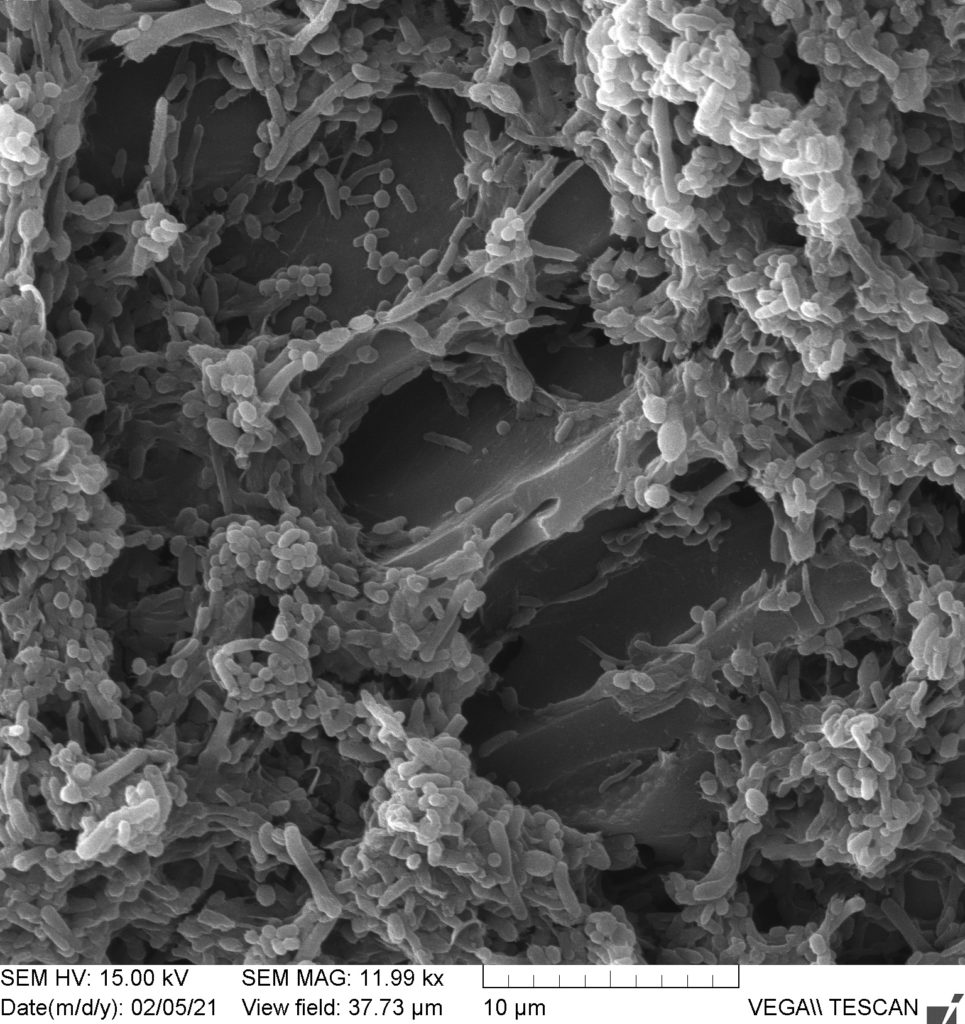
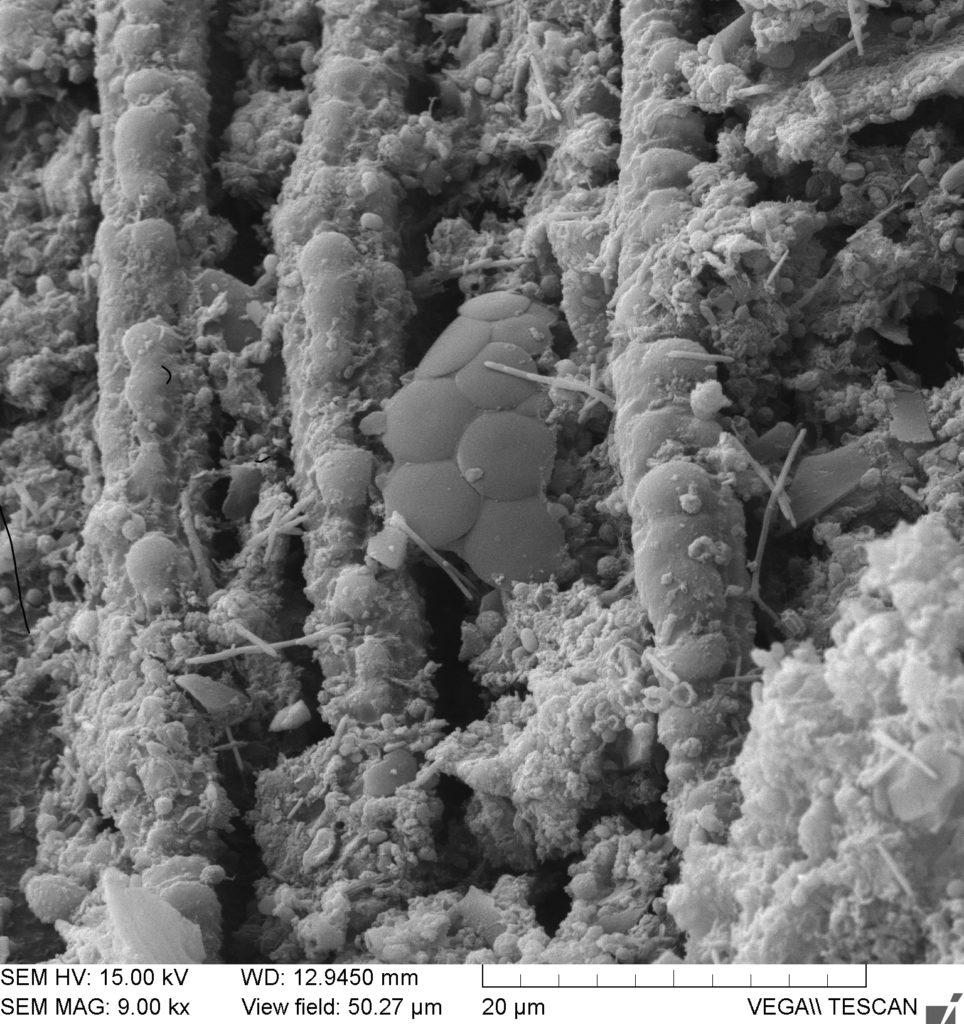
SEM images typically reveal biochar acting as a persistent porous scaffold, extensively colonised by microbial biofilms. These biofilms subsequently form stabilised organic coatings across internal and external biochar surfaces.
Distinct mineral phases are visible integrated within these organic coatings, often appearing as bridge‑like structures linking biochar surfaces and surrounding organic matter. These mineral bridges are consistent with calcium‑mediated aggregation pathways described for ash‑derived stabilisers.
Together, these observed features are consistent with composite aggregate formation linking biochar, stabilised organic matter, and minerals. This composite structure supports long‑term soil structural persistence by physically protecting humus, moderating biological access, and reinforcing stable pore architecture.
Taken together, SEM evidence supports the interpretation that BHC functions as an integrated material system in which biological activity, structure, and persistence reinforce one another, rather than as a simple mixture of inputs.
Material intentionally covered elsewhere
The following are implementations of the BHC concept, not part of its definition, and are therefore documented on separate pages:
- SF60 – a Biochar Humus super‑compost formulation.
- CHA – a compost humification agent used upstream in production.
- Clay‑enhanced variants – R&D pathways extending mineral protection.